
St. Louis City Arrest Records and Court Charges
St. Louis City County arrest records may begin with law enforcement activity, booking, custody, or an incident report. The court charge record begins later, when the Circuit Attorney or municipal prosecutor files a formal charge in court. That distinction protects accuracy. An arrest does not prove guilt, and an arrest record does not show the final court outcome unless it is tied to a court case and disposition.
The City of St. Louis Division of Corrections runs the City Justice Center and provides the inmate locator for custody information. Court charges after arrest are tracked through Case.net, the Circuit Clerk, Municipal Court, and prosecutor case paths. For the full case file after charges are filed, including pleas and sentencing, use the St. Louis City criminal court records page. For custody or recent release status, the jail roster is a different record source.
The Circuit Attorney case information source image came from the official Circuit Attorney case information page. It matters because the Circuit Attorney directs users to Case.net and the Circuit Clerk once a state-level criminal case is filed.
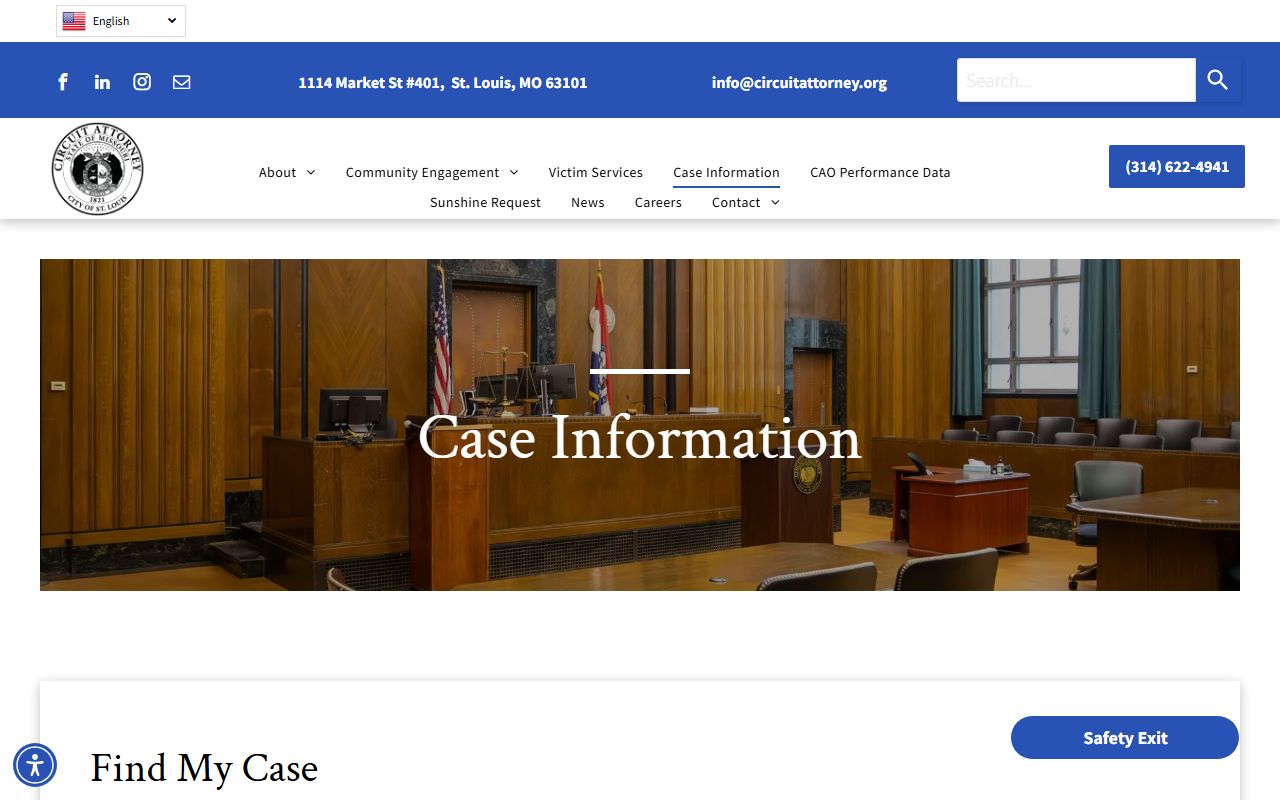
That source supports the core split: prosecutor-filed court charges are court records, while arrest reports and booking data follow separate law enforcement or custody channels.
How to Find St. Louis City Arrest Records
Start with the record type. For custody status, use the official City of St. Louis inmate locator and City Justice Center phone channels. For charges after arrest, search Case.net by case number or defendant name, then read the charge list and docket entries. For police incident reports or city agency records, use the creating agency or the city GOV/QA Sunshine process. For state prison supervision, use Missouri Department of Corrections, not the city jail locator.
- Identify whether the need is custody, law enforcement report, prosecutor charge, court docket, or final disposition.
- Search Case.net for the defendant name or known case number when formal charges may have been filed.
- Open the case and review each count, statute or ordinance, severity, filing date, bond entry, and current status.
- Check the docket for amended, reduced, dismissed, nolle prosequi, warrant, plea, or sentence entries.
- Use the Circuit Clerk for certified court copies and the city or law enforcement request path for non-court reports.
Do not assume a Clayton or St. Louis County record covers a City of St. Louis arrest. City cases use the 22nd Judicial Circuit, St. Louis City Municipal Court, the City Justice Center, and city agencies. County cases use different offices and a different jail system.
Charges Filed After Arrest
Once a person is arrested, the prosecutor decides what, if anything, to file in court. A court charge record can be created by a complaint, information, or indictment. The terms are not interchangeable. A complaint may initiate the case. An information is a prosecutor-filed formal criminal charge. An indictment is a grand-jury charging document. The charge record may then change as evidence is reviewed, plea talks occur, or the court rules on motions.
| Charging Document | Filed By | What It Does | Where It Appears |
|---|---|---|---|
| Complaint | Officer or prosecutor, depending on case path | Starts or supports the criminal accusation. | Case.net docket and court file if public. |
| Information | Prosecutor | States formal charges filed by the prosecutor. | Criminal case file and charge list. |
| Indictment | Grand jury | Charges a case after grand-jury action. | Court file unless sealed or restricted. |
Process flow: Arrest or summons › prosecutor review › complaint, information, or indictment › arraignment › charge amendments or motions › plea, trial, dismissal, or sentence.
St. Louis City Charge Status
Charge status is the heart of the court charge record. One arrest can lead to no filed case, one filed charge, or several counts. A count can stay pending, be amended, be reduced, be dismissed, be closed by nolle prosequi, or end in conviction. Read the docket and disposition by count rather than relying only on the first charge line.
| Status | What It Means | Why It Matters |
|---|---|---|
| Pending | The charge is filed and not finally resolved. | Future court dates, motions, or plea settings may still be active. |
| Amended | The prosecutor changed the charge wording, count, class, or statute. | The current charge may differ from the original arrest allegation. |
| Reduced | The charge was lowered to a lesser offense or severity level. | The final disposition may not match the original charge. |
| Dismissed | The court or prosecutor ended the count. | Check whether dismissal was with prejudice, without prejudice, or tied to another count. |
| Nolle Prosequi | The prosecutor dismissed the charge. | Missouri law may close certain records after this outcome. |
| Convicted | The case ended with a guilty plea, verdict, or qualifying finding. | Review sentence, probation, costs, and expungement eligibility separately. |
Charges vs Convictions
A charge is an accusation filed in court. A conviction is a final outcome after a guilty plea, verdict, or qualifying finding. St. Louis City County arrest records and court charges should not be read as proof of guilt by themselves. The disposition and sentence fields show what the court actually did with each count.
| Comparison Point | Charge | Conviction |
|---|---|---|
| Record Stage | Filed after arrest or summons. | Entered after plea, verdict, or court finding. |
| Legal Meaning | Allegation by prosecutor or charging authority. | Final finding or accepted plea on a count. |
| Can Change | Can be amended, reduced, dropped, or dismissed. | May be affected by appeal, probation status, or expungement if eligible. |
| Where to Verify | Charge list and docket entries. | Disposition, sentence, and certified court record. |
Note: A charge line without a conviction disposition should not be described as a finding of guilt.
Public Access to Arrest Records
RSMo 610.100 governs law enforcement arrest reports, incident reports, and investigative records. It is the key statute for the arrest-report side of St. Louis City County arrest records. Court charges, by contrast, appear in court systems when filed and remain subject to court rules, sealing orders, redaction requirements, and clerk copy procedures.
The arrest and law enforcement records source image came from the official RSMo 610.100 statute page. It should be used for the law enforcement side of an arrest, not as a substitute for the court charge docket.
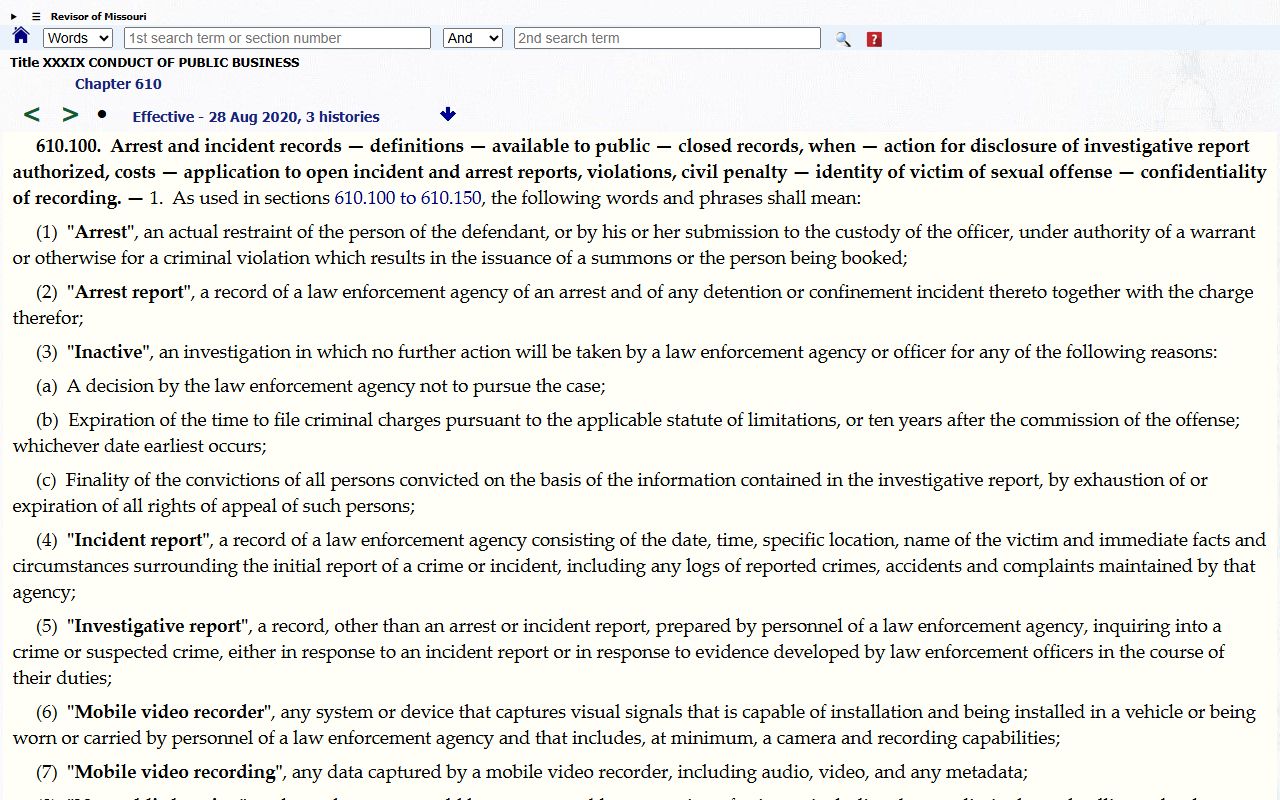
When a person needs a police report or incident record, the request usually goes through the city or the creating law enforcement agency. When the need is a filed charge, docket, plea, dismissal, or sentence, Case.net and the Circuit Clerk are the more direct paths.
Closed and Expunged Charge Records
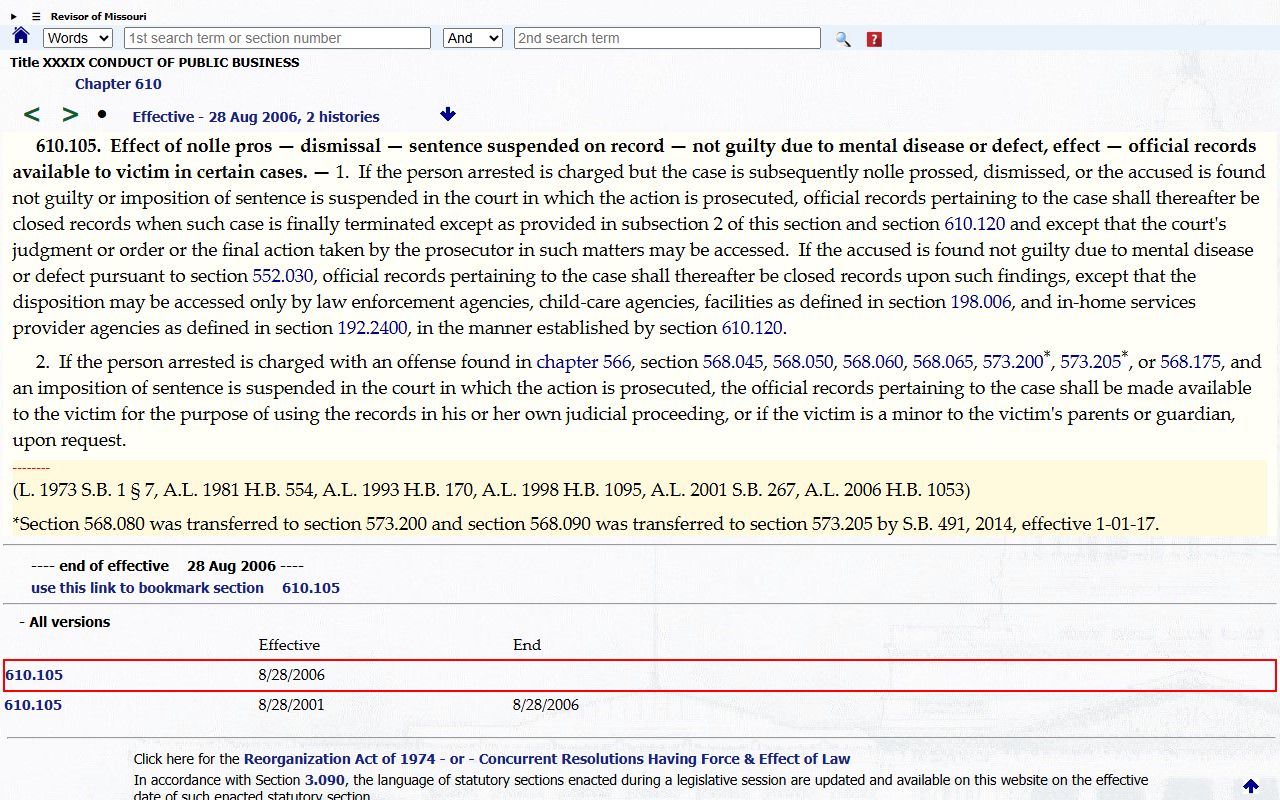
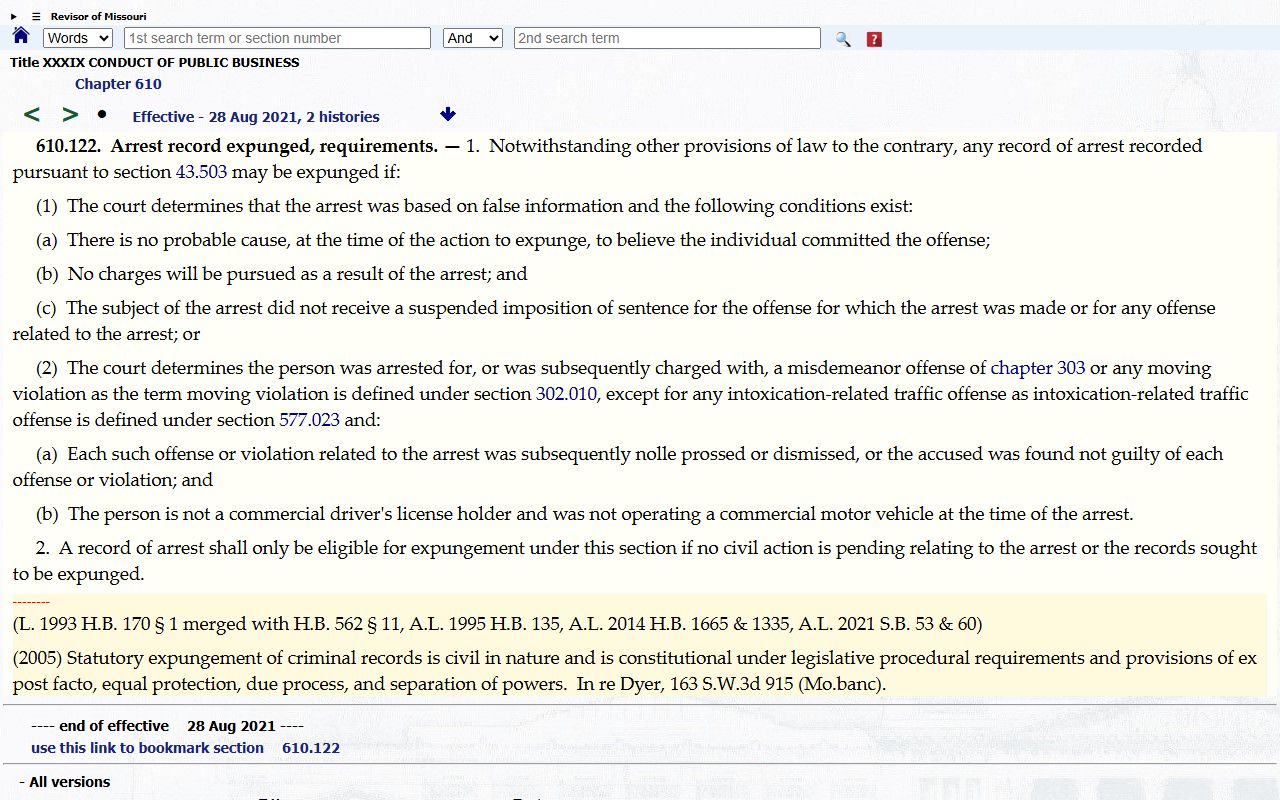
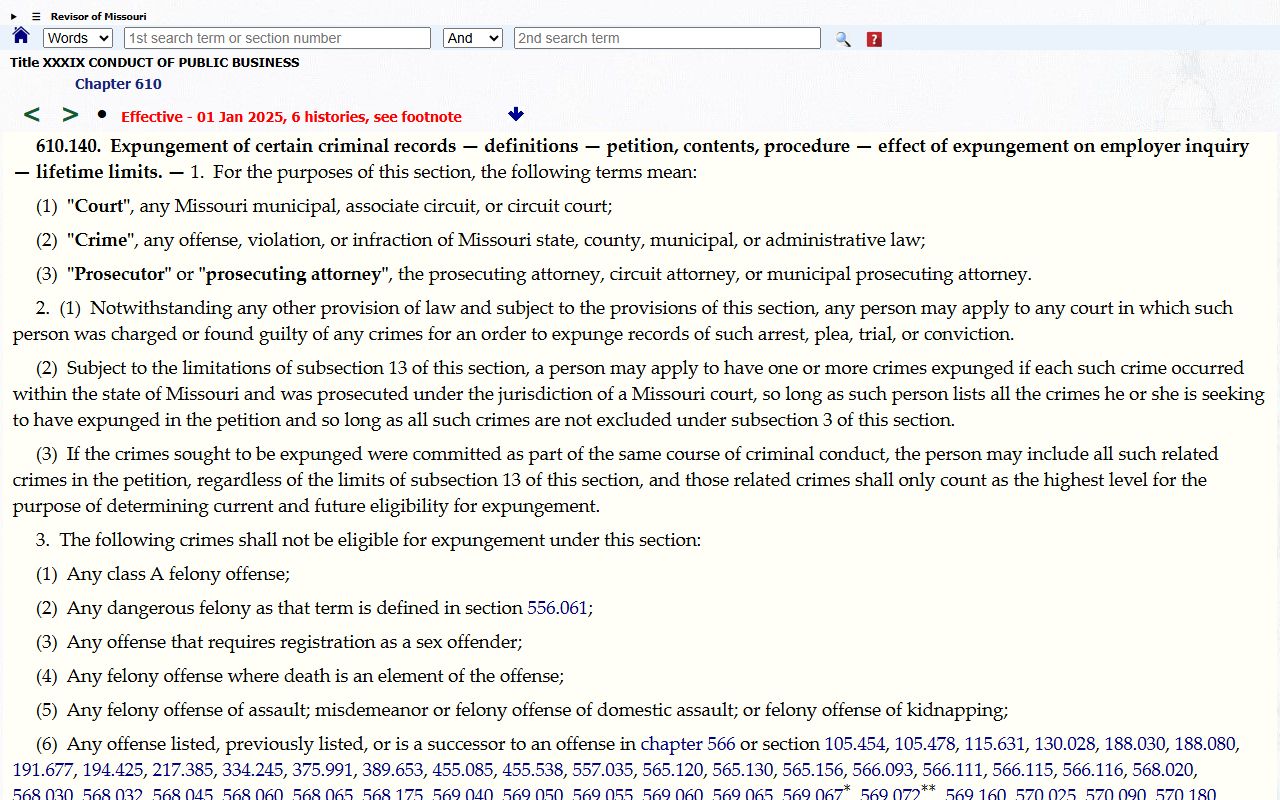
Missouri law restricts some arrest and charge records after certain outcomes. RSMo 610.105 closes certain records after nolle prosequi, dismissal, or acquittal in criminal cases. RSMo 610.122 addresses arrest record expungement. RSMo 610.140 addresses eligible criminal conviction expungement. Juvenile court records are restricted under RSMo 211.321.
The closed-record source image came from RSMo 610.105, which is important when a charge ended in nolle prosequi, dismissal, or acquittal.
The arrest expungement image came from RSMo 610.122. Expungement is a court process, not a request to a search website.
The conviction expungement image came from RSMo 610.140. That statute is separate from arrest expungement and has its own eligibility limits.
| Comparison Point | Sealed or Closed | Expunged |
|---|---|---|
| Public Search | May be hidden from ordinary public access. | Should not appear as an ordinary public record after court order. |
| Common Basis | Dismissal, acquittal, nolle prosequi, juvenile status, or court order. | Eligibility petition under arrest or conviction expungement law. |
| How to Start | Depends on statute, case result, and court rules. | File the required petition in court and serve required agencies. |
| Limits | Some agencies may retain limited access. | Not every offense, arrest, or conviction qualifies. |
Juvenile Arrest and Charge Limits
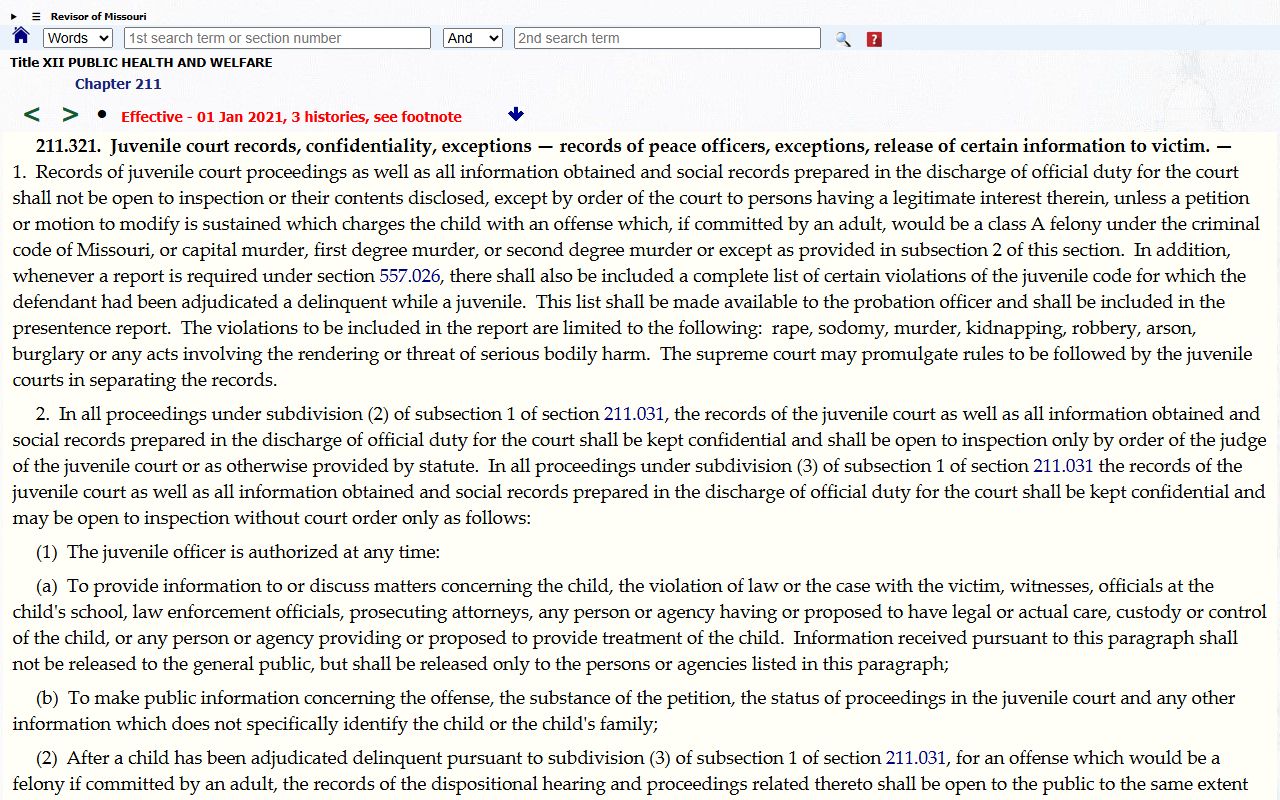
Juvenile matters are not public like ordinary adult arrest and court charge records. RSMo 211.321 restricts juvenile court records, and access can depend on juvenile law, court orders, and the Family Court/Juvenile Division. Public copy should not describe juvenile arrests or charges as freely searchable adult criminal records.
The juvenile confidentiality source image came from the official RSMo 211.321 statute page. It explains why juvenile case records need separate handling from adult criminal cases.
If a search does not return a juvenile-related matter, the absence of a public result should not be treated as proof that no court action exists. The record may be restricted by law.
Statewide Charge and Custody Checks
Missouri Department of Corrections offender search can show people sentenced to or supervised by DOC, but it is not the first source for fresh St. Louis City County arrest records. The Missouri State Highway Patrol sex offender registry is registry-specific. Federal custody uses the Bureau of Prisons locator. Those systems may be useful after a case has moved beyond city booking or local court, but they do not replace the Circuit Clerk and Case.net for filed St. Louis City court charges.
For bond or custody after arrest, the City Justice Center and Municipal Court lines may be more practical than a statewide database. Research identifies city charges bond questions through 314-622-3231 and state charges through 314-641-8214. Police custody under 24 hours may involve the first floor of the City Justice Center and SLMPD Prisoner Processing. These are custody channels, not proof of final court outcome.
Prosecutor and Defense Contacts
The Office of the Circuit Attorney prosecutes state-level criminal cases in the City of St. Louis. The research identifies the office at 1114 Market Street, Room 401, St. Louis, MO 63101, phone 314-622-4941, and email info@circuitattorney.org. The Missouri State Public Defender, St. Louis City District 22, is in the Mel Carnahan Courthouse, Suite 602, with phone 314-340-7625. These contacts can be relevant to pending charges, representation, and prosecutor-filed case information.
Certified court charge copies still go through the court. A prosecutor contact does not authenticate a court record, and a defender contact does not provide public copies for third parties. For official case documents, use Case.net to identify the case, then request copies through the Circuit Clerk or the court division that keeps the file.
Important: Public charge lookups are not FCRA consumer reports and should not be used for regulated screening decisions.