
St. Louis City Criminal Court Records
A criminal court record is the court file, not the police booking sheet. In St. Louis City County, the court record begins once a complaint, information, indictment, or municipal charging document is filed with the court. The public case may show count numbers, charge descriptions, statute or ordinance references, bond entries, warrants, counsel, motions, hearing settings, pleas, verdicts, disposition by count, sentence, probation terms, fines, costs, and restitution.
The 22nd Judicial Circuit is the main state trial court for St. Louis City. Felony and many misdemeanor criminal files are in the circuit system. Municipal Court handles city ordinance violations, many traffic matters, Metro fare violations, municipal warrants, and related fine or payment matters. Federal criminal cases in St. Louis use the U.S. District Court for the Eastern District of Missouri and are separate from city and state court files.
The criminal case information source image came from the St. Louis Circuit Attorney official site. That office is central because it prosecutes state-level criminal cases in the City of St. Louis.
The prosecutor source helps separate a filed criminal case from an arrest record. Arrest details may exist first, but the criminal court record tracks what the prosecutor filed and how the court handled it.
Search St. Louis City Criminal Cases
Public St. Louis City County criminal court records are first searched through Missouri Case.net. Case.net supports case number, litigant name, filing date, scheduled hearing, and judgment searches. If the exact case number is known, use it first. If only the defendant name is known, compare the court, case type, filing date, and city before relying on the result. St. Louis City is the 22nd Judicial Circuit and should not be confused with St. Louis County's 21st Judicial Circuit in Clayton.
- Open Case.net and choose case number search or litigant name search.
- Confirm that the result belongs to St. Louis City, the 22nd Judicial Circuit, Municipal Court, or the correct federal venue.
- Open the case and read the charge list, docket entries, bond entries, counsel entries, and next hearing date.
- Check each count separately because one case can include charges with different pleas, dismissals, sentences, or costs.
- Request a certified copy from the St. Louis Circuit Clerk when a court-authenticated record is required.
The Circuit Attorney case information page directs users to Case.net and the St. Louis Circuit Clerk for case viewing and downloads. For criminal defense representation questions, the Missouri State Public Defender St. Louis City District 22 is a separate office from the clerk and prosecutor.
St. Louis City Criminal Case Flow
Criminal court records make more sense when read in sequence. A case may begin with charges filed, then move through arraignment, bond review, discovery, motions, pretrial conferences, plea negotiations, trial settings, verdict or plea, disposition, sentencing, probation, payment, or appeal. The docket may also show warrants, recall orders, continuances, and compliance events.
Case flow: Charges Filed › Arraignment › Pretrial and Motions › Plea or Trial › Disposition › Sentencing
| Stage | What Happens |
|---|---|
| Charges Filed | The Circuit Attorney or municipal prosecutor files the complaint, information, indictment, or ordinance charge. |
| Arraignment | The defendant is advised of the charge and enters an initial plea or receives a setting. |
| Pretrial and Motions | Attorneys file motions, request discovery, address bond, and prepare for plea or trial. |
| Plea or Trial | The case resolves by plea, dismissal, trial verdict, or other court order. |
| Disposition and Sentence | The court records the result and any jail, prison, probation, fine, cost, restitution, or compliance terms. |
What St. Louis City Criminal Records Show
A criminal court record can show more than the charge name. It can show whether the case is pending or closed, who represents the defendant, whether bond was set, whether a warrant was issued or recalled, what motions were filed, whether a plea was entered, and how each count ended. Charge status matters. A charge may be amended, reduced, dismissed, resolved by plea, resolved by trial, or closed after nolle prosequi.
| Field | What It Shows |
|---|---|
| Case Number | The court file number, often with St. Louis City circuit coding such as 22SL and criminal case type letters. |
| Defendant | The person charged in the case, with identifying details limited by court access rules. |
| Prosecutor | The Circuit Attorney or municipal prosecuting authority tied to the filed charges. |
| Charges | Count numbers, offense descriptions, statute or ordinance references, severity, and amendments where public. |
| Plea | The defendant's answer to each charge, such as guilty or not guilty. |
| Disposition | The result for the case or count, including conviction, acquittal, dismissal, or nolle prosequi. |
| Sentence | Jail, prison, probation, fines, costs, restitution, treatment, or other terms ordered after conviction. |
| Docket Entries | Hearings, motions, warrants, bond actions, continuances, orders, and compliance updates. |
For a closer look at the charging document and charge status before final outcome, use the St. Louis City arrest records and court charges resource. The criminal court file remains the place to verify the full case outcome and sentence.
Prosecutor and Public Defender Records
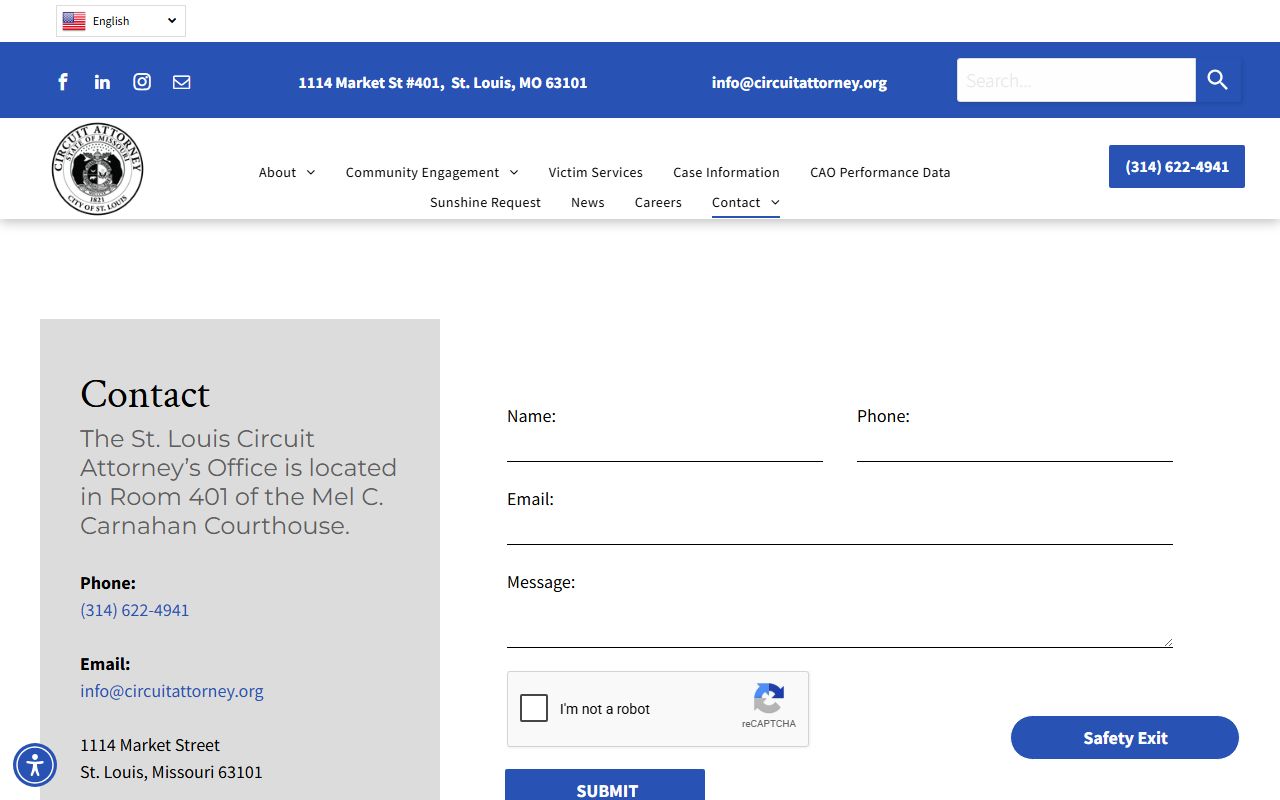
The Office of the Circuit Attorney is the prosecutor for state-level criminal cases in the City of St. Louis. The research identifies the office at 1114 Market Street, Room 401, St. Louis, MO 63101, with phone 314-622-4941 and email info@circuitattorney.org. Prosecutor pages can help confirm office role, contact points, victim services, diversion, warrant office functions, and case information directions, but the court record itself is kept through the clerk and court systems.
The Circuit Attorney contact source image came from the official Circuit Attorney contact page. It is useful when a criminal court record question involves prosecution contacts, not certified copy retrieval.
The Missouri State Public Defender District 22 source image came from the St. Louis City Public Defender page. The office provides defense representation to indigent citizens accused or convicted of crimes in Missouri and is located in the Mel Carnahan Courthouse.
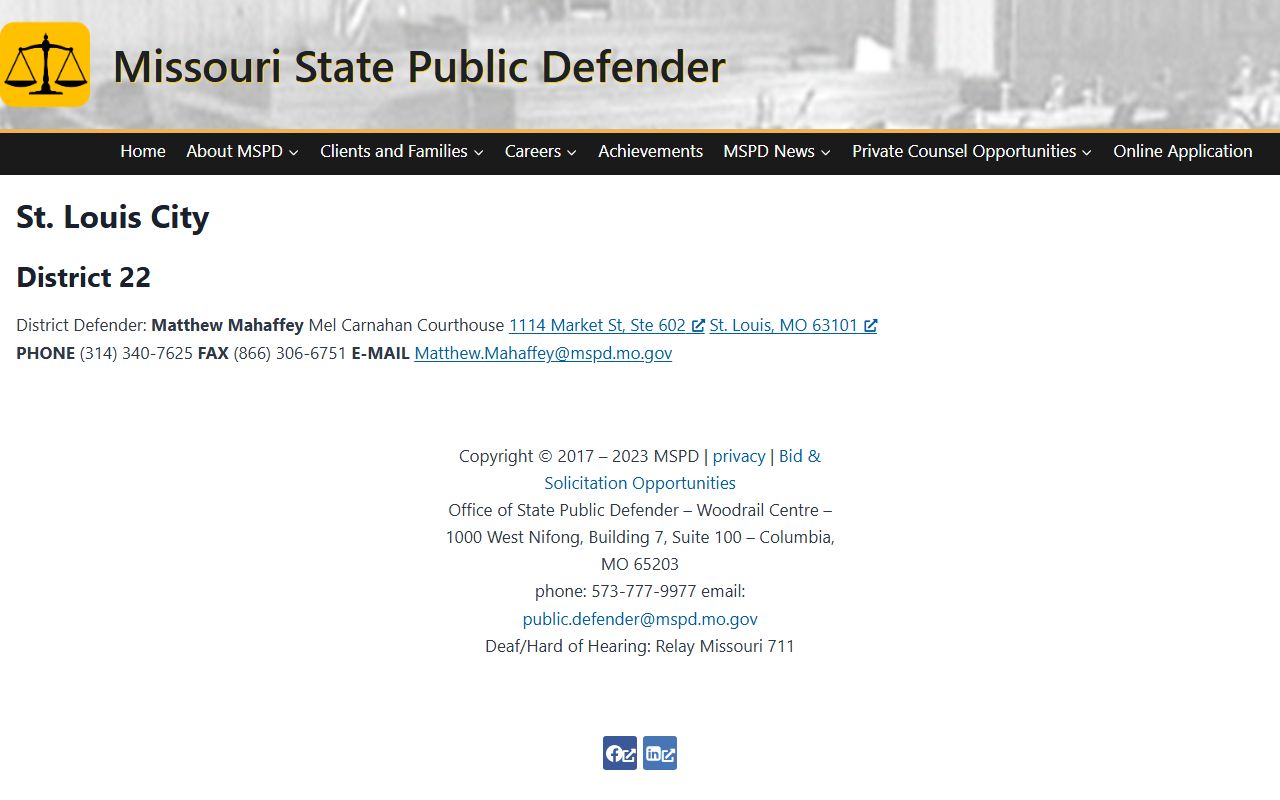
Neither office replaces the court docket. The prosecutor and defender may be listed in the case, but certified records and public docket events remain court records.
Charges vs Convictions
Being charged is not the same as being convicted. A St. Louis City County criminal court record may show a charge that was later dismissed, reduced, amended, or resolved by acquittal. The final disposition and sentence fields carry the most weight when reading outcome. One case can also have several counts, and each count can end in a different way.
| Comparison Point | Charge | Conviction |
|---|---|---|
| Stage | Formal accusation filed in court. | Final result after guilty plea, verdict, or qualifying finding. |
| Record Meaning | Shows what was alleged by the prosecutor. | Shows what the court accepted or found proved. |
| Can Change | May be amended, reduced, dropped, or dismissed. | May later be affected by appeal, probation, set-aside, or expungement if eligible. |
| Best Field to Check | Charge list and docket entries. | Disposition and sentence fields. |
Statewide Criminal Record Channels
Statewide records can supplement, but not replace, a St. Louis City criminal case file. The Missouri Department of Corrections offender search is for people sentenced to or supervised by DOC. The Missouri State Highway Patrol sex offender registry is for registered sex offender records. Federal custody uses the Bureau of Prisons inmate locator. These databases answer different questions from a circuit criminal docket.
The Missouri DOC source image came from the Missouri Department of Corrections offender search. Use it for state prison or supervision status, not for the first view of a St. Louis City court case.
The Missouri State Highway Patrol registry image came from the state sex offender registry search. It is registry-specific and should not be treated as a full criminal court record.
The federal custody image came from the Bureau of Prisons inmate locator. Federal custody is separate from local St. Louis City case records and from the City Justice Center.
Sealed vs Expunged Criminal Records
Missouri law can limit public access to criminal records after certain outcomes. RSMo 610.105 closes certain criminal records after nolle prosequi, dismissal, or acquittal. RSMo 610.140 covers eligible conviction expungement after statutory requirements. Juvenile records are restricted under RSMo 211.321.
| Comparison Point | Sealed or Closed | Expunged |
|---|---|---|
| Public Visibility | Hidden or limited from ordinary public access. | Closed from ordinary public access after a qualifying court order. |
| Common Trigger | Court order, juvenile status, dismissal, acquittal, or statutory closure. | Eligibility petition, statutory waiting rules, service, no successful objection, and court order. |
| How It Starts | May occur by rule, statute, or court order. | Filed as a court petition, not by asking a website to delete a result. |
| Practical Effect | Case may not appear in public search. | Public access is limited, but not every offense or case qualifies. |
Note: A missing public result can mean sealed status, wrong venue, older indexing, or a spelling mismatch.
Certified Criminal Case Copies
Certified criminal court records come from the St. Louis Circuit Clerk, not from a screenshot. The 22nd Judicial Circuit certified copy instructions say users may email requests and a Certified Copies Department member will respond with an estimate and payment instructions. The public research did not capture a complete per-page copy fee, so the correct copy cost is estimate-required. A strong request includes the case number, defendant name, document title, filing date if known, and whether certification is needed.
For criminal court business at the courthouse, the Circuit Attorney and Public Defender are both in the Mel Carnahan Courthouse, while many court and clerk functions are in the downtown circuit complex. Municipal ordinance and traffic cases have their own Municipal Court counter. The right office depends on whether the record is a state criminal case, municipal charge, federal case, custody record, or agency report.